Tax-Exempt Organization Classifications: What the IRS Data Shows

Key Takeaways
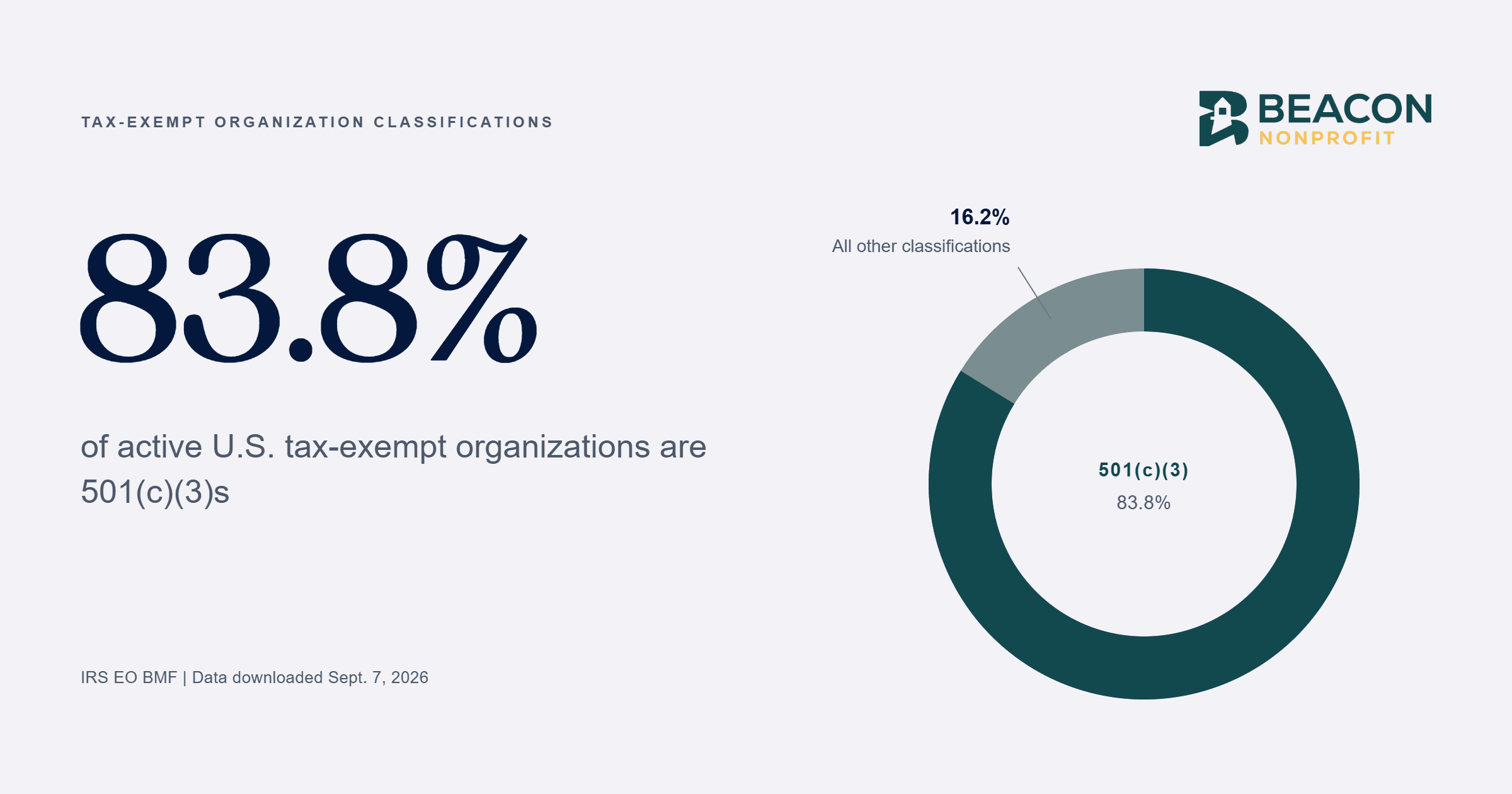
501(c)(3) organizations account for 83.8% of the 1,956,822 active tax-exempt organizations in the IRS dataset, making it the dominant classification by a wide margin.
The next-largest classification, 501(c)(4), represents just 3.5% of active organizations, just a fraction of 501(c)(3)'s share.
The five largest classifications together account for 94.9% of all active tax-exempt organizations analyzed.
501(c)(3) is the only tax-exempt classification that allows qualifying organizations to receive tax-deductible charitable contributions, which distinguishes it from most other classifications.
The right tax-exempt classification depends on an organization's purpose and activities, not on which classification is most common.
According to Beacon Nonprofit's analysis of IRS Exempt Organizations Business Master File data, 501(c)(3) organizations account for 83.8% of all active tax-exempt organizations in the United States. This article breaks down how the major classifications compare, what the data shows, and how to think about classification when starting a nonprofit.
501(c)(3) organizations account for 83.8% of all active tax-exempt organizations in the United States, according to Beacon Nonprofit's analysis of the IRS Exempt Organizations Business Master File (EO BMF). That figure comes from a dataset of 1,956,822 active organizations and puts 501(c)(3) in a category of its own among federal tax-exempt classifications. This article breaks down what the data shows, how the major classifications compare, and what classification means for founders thinking about starting a nonprofit. Findings from Beacon's analysis of IRS data are part of an ongoing series examining the state of the nonprofit sector in America, including The Health and Growth of the U.S. Nonprofit Sector: What the IRS Data Shows, The State of Nonprofits in America, Automatic 501(c)(3) Revocations in America, and Where Active 501(c)(3)s Have Recent IRS Ruling Dates.
What is the Most Common Tax-Exempt Classification?
Quick Answer
According to Beacon Nonprofit's analysis of IRS Exempt Organizations Business Master File data downloaded September 8, 2026, 501(c)(3) organizations account for 83.8% of the 1,956,822 active tax-exempt organizations included in the analysis. The five largest classifications, led by 501(c)(3), account for 94.9% of active organizations analyzed.
What the IRS Data Shows
Three findings stand out from the dataset:
501(c)(3) dominates: 1,640,646 active organizations, or 83.8% of the dataset.
The next-largest classification is much smaller: 501(c)(4) represents 68,417 organizations, or 3.5%.
Five classifications account for most organizations: The five largest classifications represent 1,852,532 organizations, or 94.9% of the dataset.
How Common Is Each Tax-Exempt Classification?
The table below shows the eight categories represented in the dataset, drawn from Beacon Nonprofit's analysis of the IRS EO BMF downloaded September 8, 2026.
| Classification | Active Count | Share of Total |
|---|---|---|
| 501(c)(3) — Charitable, Religious, Educational | 1,640,646 | 83.8% |
| 501(c)(4) — Social Welfare Organizations | 68,417 | 3.5% |
| 501(c)(6) — Business Leagues, Chambers of Commerce | 57,720 | 2.9% |
| 501(c)(7) — Social and Recreational Clubs | 46,420 | 2.4% |
| 501(c)(5) — Labor, Agricultural, Horticultural | 43,622 | 2.2% |
| 501(c)(8) — Fraternal Beneficiary Societies | 32,958 | 1.7% |
| 501(c)(19) — Veterans Organizations | 24,648 | 1.3% |
| All other classifications combined | 42,391 | 2.2% |
Source: IRS Exempt Organizations Business Master File (EO BMF), downloaded September 8, 2026. Beacon Nonprofit's analysis of IRS data.
501(c)(4) — Social Welfare Organizations (68,417 active, 3.5%) 501(c)(4) organizations are civic leagues and social welfare organizations operated for the promotion of social welfare. Neighborhood associations, certain advocacy groups, and community action organizations often fall into this category. Unlike 501(c)(3), donations to most 501(c)(4) organizations are generally not tax-deductible for donors. For a detailed side-by-side breakdown, see 501(c)(3) vs. 501(c)(4): What Is the Difference for Nonprofits?
501(c)(6) — Business Leagues and Chambers of Commerce (57,720 active, 2.9%) 501(c)(6) organizations include business leagues, chambers of commerce, real estate boards, and trade associations. They exist to promote the common business interests of their members rather than to engage in charitable activity. Membership dues and activities are organized around a specific industry or profession.
501(c)(7) — Social and Recreational Clubs (46,420 active, 2.4%) 501(c)(7) organizations are clubs organized for pleasure, recreation, and similar non-profitable purposes. They are membership-based, and their net earnings may not benefit any private individual. Country clubs, hobby clubs, and amateur sports organizations that do not qualify under another classification often fall here.
501(c)(5) — Labor, Agricultural, and Horticultural Organizations (43,622 active, 2.2%) 501(c)(5) covers labor unions, farm bureaus, and organizations that work to improve the conditions of those engaged in agricultural or horticultural pursuits. These organizations serve their members and the industries they represent rather than the general public in the way a 501(c)(3) does.
501(c)(8) — Fraternal Beneficiary Societies (32,958 active, 1.7%) 501(c)(8) organizations are fraternal beneficiary societies operating under the lodge system. To qualify, they must provide life, sick, accident, or other benefits to their members or their dependents. These are distinct from social clubs and have a specific mutual aid function built into their structure.
501(c)(19) — Veterans Organizations (24,648 active, 1.3%) 501(c)(19) organizations are posts, auxiliaries, or trusts organized for veterans of the U.S. Armed Forces. The IRS sets specific membership requirements for this classification. Veterans organizations that do not meet those requirements may qualify under a different classification, such as 501(c)(3) or 501(c)(4).
Every classification in this table represents real organizations with distinct purposes and governing rules. The 42,391 organizations grouped as "all other classifications" span more than a dozen additional IRS categories, each with its own qualifying criteria.
Why Are Most Tax-Exempt Organizations 501(c)(3)s?
The IRS defines 501(c)(3) as covering organizations organized and operated for charitable, religious, educational, scientific, or literary purposes. The classification also includes organizations that test for public safety, foster national or international amateur sports competition, or work to prevent cruelty to children or animals. That range of qualifying purposes is broad, which means many different kinds of organizations can legitimately seek this classification.
One characteristic of 501(c)(3) status that is worth understanding is that qualifying organizations can receive tax-deductible charitable contributions. Donors who give to a 501(c)(3) may be able to deduct those contributions on their federal tax returns, subject to IRS rules. This is not available for most other classifications.
Organizations seeking 501(c)(3) recognition typically apply using IRS Form 1023. Smaller organizations that meet certain eligibility requirements may use IRS Form 1023-EZ, a streamlined version of the application. Some organizations, including churches and certain small organizations, may qualify for 501(c)(3) status without filing an application for recognition at all, though they are still subject to the same operational requirements.
If your organization is considering this path, How to Apply for 501(c)(3) Tax-Exempt Status walks through the process in plain language.
It is worth noting that the dataset shows how organizations are currently classified. The data does not itself explain why 501(c)(3) is the most common classification. The broad scope of qualifying purposes and the tax-deductibility of contributions provide useful context, but the data cannot speak to the decisions individual organizations made.
What the Data Does and Does Not Tell Us
The IRS EO BMF shows how organizations are classified. It does not explain why any organization selected a particular classification, and Beacon's analysis does not claim otherwise.
501(c)(3) is the most prevalent classification in the dataset by a wide margin. That prevalence reflects the breadth of qualifying purposes under that section of the tax code and the characteristics associated with it. It does not mean 501(c)(3) is the appropriate choice for every organization. The IRS defines each classification specifically, and an organization's purpose and activities determine which classification fits, not how common that classification is.
The 316,176 active non-501(c)(3) organizations in the dataset are classified that way because their purposes align with a different section of the tax code. A labor union, a chamber of commerce, and a fraternal society each have a classification designed for their structure and mission.
Choosing the Right Classification
Classification is determined by what an organization does and why it exists, not by what is most common. The IRS sets specific qualifying criteria for each category, and an organization needs to meet those criteria to apply for and maintain a given classification.
For founders exploring their options, 5 Types of Nonprofit Structures provides a deeper look at how different structures compare. Understanding the distinctions before you file helps ensure your organization is set up in a way that matches its actual purpose.
If you have questions about compliance requirements once your organization is established, the Nonprofit Compliance Checklist covers what founders need to know after formation.
What Comes Next
Understanding how tax-exempt classifications are distributed is a starting point, not a finish line. The right classification for your organization depends on your mission, your activities, and how you plan to fund your work.
If you are ready to move from research to action, How to Form a Nonprofit Organization in 8 Steps walks through the full formation process. And if 501(c)(3) status looks like the right fit, How to Apply for 501(c)(3) Tax-Exempt Status covers what the application process involves.
- IRS. Exempt Organizations Business Master File Extract (EO BMF).
- IRS. Types of Tax-Exempt Organizations.
- IRS. Charitable Organizations — 501(c)(3).
- IRS. About Form 1023, Application for Recognition of Exemption Under Section 501(c)(3) of the Internal Revenue Code.
- IRS. About Form 1023-EZ, Application for Recognition of Exemption Under Section 501(c)(3) of the Internal Revenue Code.
Frequently Asked Questions
According to Beacon Nonprofit's analysis of IRS Exempt Organizations Business Master File data downloaded September 8, 2026, 501(c)(3) organizations account for 83.8% of the 1,956,822 active tax-exempt organizations in the dataset.
501(c)(3) organizations are formed for charitable, religious, educational, scientific, or literary purposes, and qualifying organizations can receive tax-deductible charitable contributions. 501(c)(4) organizations are civic leagues and social welfare organizations; donations to most 501(c)(4)s are generally not tax-deductible for donors.
The IRS defines specific qualifying criteria for each tax-exempt classification. The right classification is the one that matches your organization's actual purpose and activities. Reviewing the IRS descriptions for each classification and consulting a qualified advisor if needed is the best starting point.
Not all organizations are required to file an application for recognition. Churches and certain small organizations may qualify for 501(c)(3) status without submitting Form 1023 or Form 1023-EZ, though they are still subject to the same operational requirements under the tax code.
The data referenced in this article comes from the IRS Exempt Organizations Business Master File (EO BMF), a publicly available dataset maintained by the IRS. Beacon Nonprofit's analysis used a download of the EO BMF dated September 8, 2026, filtered to active organizations only (STATUS = 01 or 02).
Related Articles
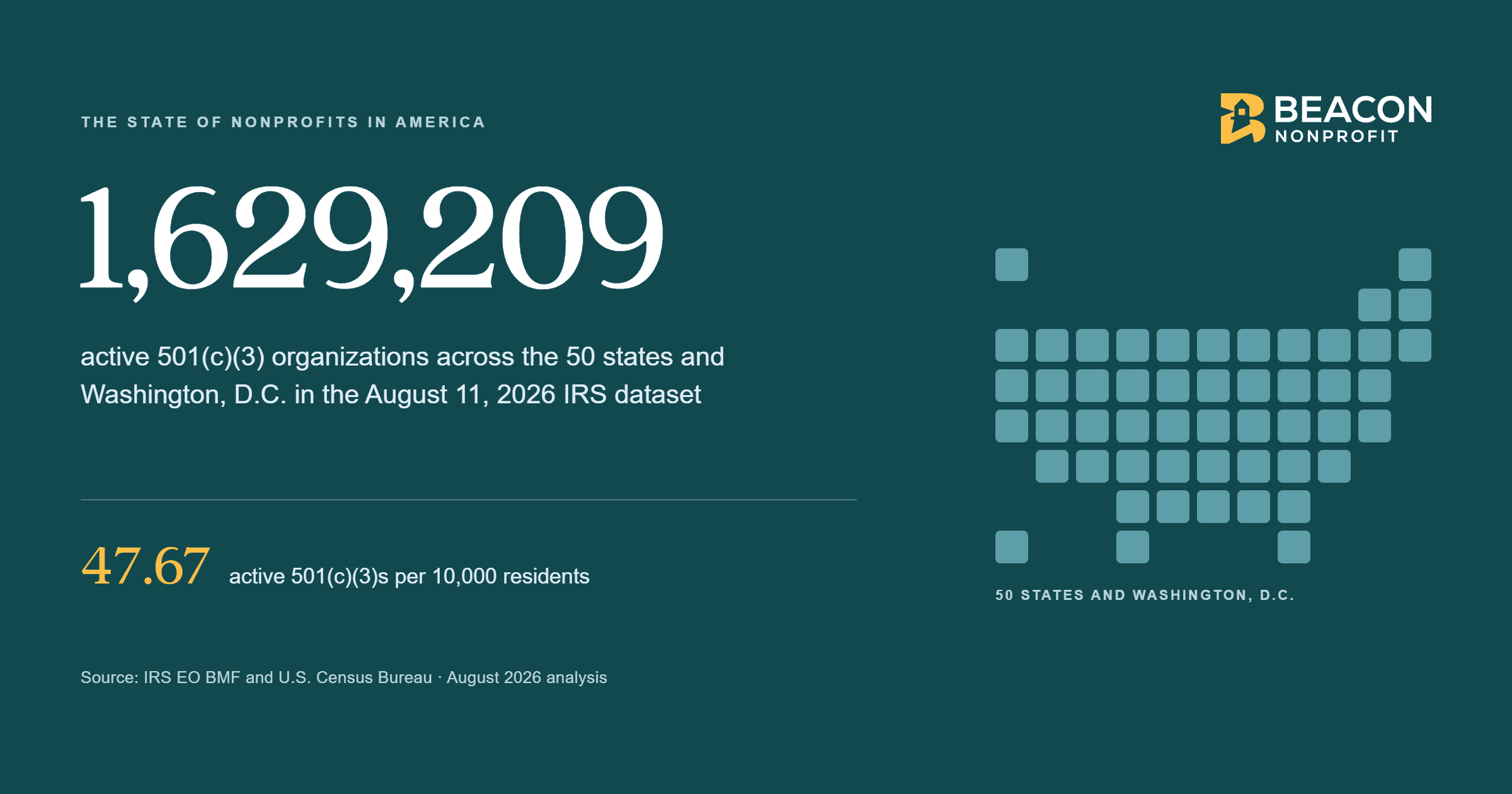
The State of Nonprofits in America: A State-by-State Analysis
How does the nonprofit sector differ from state to state? This analysis of IRS and U.S. Census data compares active 501(c)(3) organizations by state, population, mission area, and IRS recognition date.
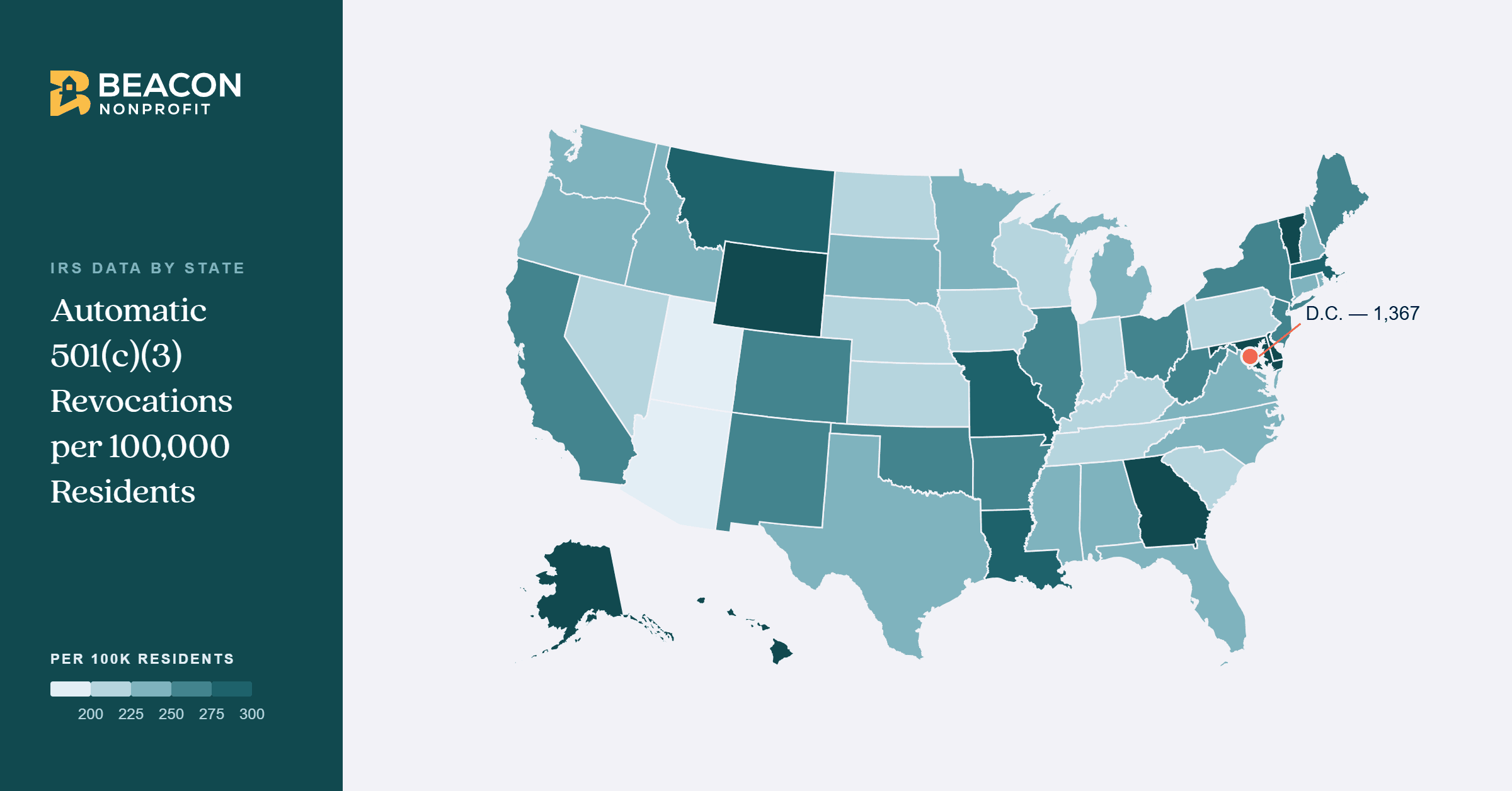
Automatic 501(c)(3) Revocations in America: IRS Data by State
See how automatic 501(c)(3) revocations vary across the United States, including state-by-state rates, historical trends, and what nonprofits need to know about maintaining tax-exempt status.

How to Apply for 501(c)(3) Tax-Exempt Status
Applying for 501(c)(3) tax-exempt status allows nonprofit organizations to receive tax-deductible donations and operate as federally recognized charities. This guide explains the steps required to apply, including forming a nonprofit corporation, obtaining an EIN, preparing governance documents, and submitting IRS Form 1023 or Form 1023-EZ.

Types of Nonprofit Structures Explained
Your legal structure shapes everything from how your board operates to how you apply for tax-exempt status. Learn the main nonprofit structures, what makes them different, and how to choose the right one for your mission.

Nonprofit Compliance Checklist: What Every Founder Needs to Know
Stay organized and protect your mission with this nonprofit compliance checklist. Learn which filings apply after formation, including annual reports, IRS Form 990, charitable solicitation registration, and more.

How to Form a Nonprofit Organization in 8 Steps
Starting a nonprofit organization is one of the most meaningful steps you can take for your mission, and it's more manageable than it might seem.

501(c)(3) vs. 501(c)(4): What Is the Difference for Nonprofits?
Not all nonprofits operate under the same tax classification. Two of the most common tax-exempt classifications are 501(c)(3) charitable organizations and 501(c)(4) social welfare organizations. Understanding the difference helps founders choose the classification that best fits their mission, fundraising plans, and long-term goals.
The Health and Growth of the U.S. Nonprofit Sector
IRS data reveals a U.S. nonprofit sector of more than 1.6 million active 501(c)(3) organizations, and a third of them received federal recognition since 2020. Here's what the numbers show about sector size, composition, and long-term sustainability.
Get Nonprofit Tips and Compliance Guidance
Subscribe for updates, insights, and resources that help you stay compliant and grow your mission.